
Finding the best canister filters for your tank means matching flow rate, media volume, and maintenance rhythm to your actual bioload. It’s not about grabbing the biggest box on the shelf. I made that mistake once, buying a canister rated for double my tank size because bigger felt safer. As a result, my stand cabinet couldn’t close afterward.
Disclosure: This post contains affiliate links. If you purchase through a link on this page, we may earn a small commission at no extra cost to you. We only recommend products we’d use in our own tanks.
I’ve run canister filters on three different tanks over the past several years: a 75-gallon community tank, a 40-gallon planted tank, and a 20-gallon that started out on a hang-on-back filter. I switched that last one after getting tired of weekly cartridge changes. Along the way I’ve used an Eheim Classic and a Fluval 407, plus one budget canister I eventually replaced. In particular, that last swap taught me more about what separates a reliable canister from a cheap one than any spec sheet does.
What Actually Matters in a Canister Filter
Every canister filter claims to be quiet, powerful, and easy to maintain. However, here’s what actually separates a good match for your tank from an expensive mistake.
- Turnover rate, not just rated GPH. The general rule for freshwater tanks is 4 to 10 times the tank’s volume in gallons per hour, with most community setups clustering around 4 to 6 times. Manufacturer-rated GPH numbers are measured at zero head height, so real-world output after plumbing, media, and a dirty filter usually runs 25 to 50 percent lower. As a result, size up from the box number, not down.
- Media volume. A canister’s whole advantage over a hang-on-back is room for layered mechanical, biological, and chemical media. More media volume means more surface area for beneficial bacteria and longer stretches between cleanings.
- Noise. A properly primed canister under the stand should produce almost no audible sound beyond a faint hum. If yours is gurgling or rattling, air is trapped somewhere in the line.
- Maintenance interval. Mechanical media generally needs attention every 4 to 6 weeks, and biological media can usually stretch to 6 to 12 weeks. A larger canister with more media capacity buys you longer intervals between cleanings.
- Priming method. Some canisters need you to manually prime the siphon by hand; others use an electronic auto-prime system that fills the housing and purges air at power-up. Manual priming isn’t hard once you’ve done it a few times, but it’s worth knowing before you buy.
- Headroom for growth. Buying one size up from your current tank gives you a maintenance-interval cushion and room if you add fish later. That said, it’s possible to overdo it. If you’re weighing whether more filtration is ever a problem, our guide to over-filtering a tank covers where the real limits are.
Canister Filters vs HOB: When You Actually Need to Upgrade
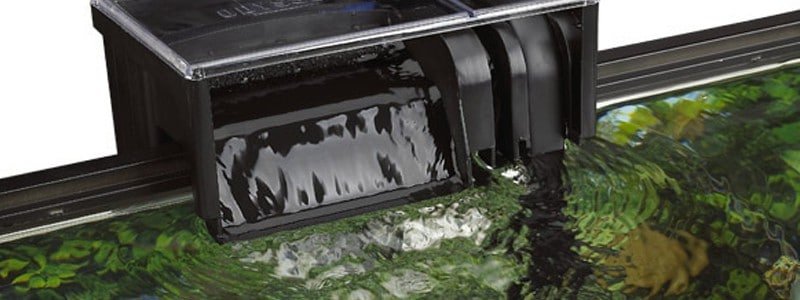
Hang-on-back filters cover most tanks from 10 to 75 gallons well, and there’s no reason to replace one that’s keeping your water clean. However, canister filters take over where HOB units start to struggle, generally in the 40 to 300 gallon range. They pull ahead on mechanical and biological filtration because of their layered media trays.
The tradeoff is setup complexity. A canister needs priming and some hose routing under the stand, while a HOB just clips onto the rim. In exchange, you get a filter that runs essentially silent once primed, instead of the slight pump hum and waterfall sound of a HOB return.
A few signals it’s time to upgrade:
- Your tank is over 55 gallons and your current HOB is struggling to keep up
- You keep heavy-bioload fish such as cichlids, plecos, goldfish, or an oscar
- You want a genuinely quiet setup, for example in a bedroom
- You’re aiming for a cleaner aquascape look with less visible hardware
- You’d rather clean a filter every 6 to 8 weeks than every 2
You don’t have to choose one or the other, either. For instance, plenty of keepers run a canister alongside their existing HOB for redundancy and extra biological capacity, especially on heavily stocked tanks. If that’s the route you’re considering, our guide to running multiple filters on one tank covers how to combine them without overcomplicating maintenance.
The Best Canister Filters at a Glance
Next, here’s how all seven picks stack up before we get into the details on each one.
| Product | Best For | Tank Size | Key Spec | Price |
|---|---|---|---|---|
| Eheim Classic 150 | Smaller community tanks | Small (compact) | Manual-prime workhorse | $$ |
| Fluval 407 | 50–100 gal community | 50–100 gal | Balanced flow, quiet | $$$ |
| Fluval FX4 | Large tanks | 125–250 gal | High-capacity FX-series | $$$ |
| Fluval FX6 | Heavy bioload, up to 400 gal | Up to 400 gal | 925 GPH, self-priming | $$$$ |
| Marineland Magniflow 220 GPH | Budget standard community tanks | Small–mid community | 220 GPH rated flow | $$ |
| Penn-Plax Cascade 1000 | Best value under $100 | Up to 100 gal | 265 GPH rated flow | $ |
| Zoo Med Nano 10 | Nano tanks under 10 gal | Up to 10 gal | Compact external design | $ |
1. Eheim Classic 150, Best for Smaller Community Tanks
Eheim’s Classic line has been the default recommendation in fishkeeping forums for decades, and mine has been running quietly under a 29-gallon community tank for two years now without a single hiccup.
The Classic 150 sits at the small end of Eheim’s canister lineup, and it’s genuinely a workhorse: simple mechanically, reliable, and built to last. The honest caveat: priming is manual, and there’s no electronic auto-prime button to make it easier.
Pros and Cons
Pros
- Long track record of reliability among hobbyists
- Simple internal design means fewer parts to fail
- Runs quiet once fully primed
Cons
- Manual priming takes a few tries to get comfortable with
- No electronic features found on newer canisters
- A premium price for a tank size a HOB could also handle
Works for: smaller community tanks where a compact canister makes sense. EHEIM Classic Canister Filter 2211, Classic 150 – PetOverstock
2. Fluval 407 Performance Canister Filter, Best for 50–100 Gallon Community Tanks
✦ TOP PICKThis is the filter I’d point most readers toward. Specifically, the 407 is rated for 50 to 100 gallon aquariums, which covers the tank size where the largest share of upgrading fishkeepers actually land: a 55 or 75 gallon community tank outgrowing its HOB.
I moved my 75-gallon community tank onto a 407 after years on a hang-on-back, and the difference in water clarity within the first week was noticeable.
Pros and Cons
Pros
- Sized well for the 50–100 gallon range most upgraders need
- Generous media volume for its footprint
- Quiet operation once primed and settled in
Cons
- Priced above budget canisters in this size class
- Overkill if your tank is under 40 gallons
- Takes more under-stand space than a HOB alternative
Works for: 50 to 100 gallon tanks. Fluval 407 Perfomance Canister Filter – for Aquariums Up to 100 Gallons –
3. Fluval FX4, Best for 125–250 Gallon Tanks
The FX4 sits between the 407 and the FX6 in Fluval’s lineup, built for larger tanks that need more flow and media capacity than a mid-size canister can provide but don’t quite need the FX6’s full output.
Pros and Cons
Pros
- Strong middle ground between mid-size canisters and the FX6
- Shares the FX-series’ large media basket design
- Handles bigger tanks without stepping up to the largest, priciest unit
Cons
- Large footprint compared to mid-size canisters
- Overkill for anything under roughly 100 gallons
- Costs meaningfully more than the 407
Works for: large tanks in the 125 to 250 gallon range. Fluval FX4 Canister Filter for Aquariums up to 250 Gal
4. Fluval FX6, Best for Heavy Bioload and Large Tanks (Up to 400 Gallons)
✦ BEST FOR LARGE TANKSThe FX6 is rated for aquariums up to 400 gallons with a flow rate of 925 GPH (3,500 LPH), and it’s electronically self-priming: it fills the canister and purges trapped air automatically at power-up instead of requiring a manual pump.
Pros and Cons
Pros
- Highest rated capacity in this lineup, up to 400 gallons
- Self-priming, no manual pump routine
- Massive media volume, ideal for heavy bioload species like cichlids and plecos
Cons
- The highest price point of any pick on this list
- Large physical size needs real cabinet space
- Way more filter than a 40 or 55 gallon tank needs
Works for: large tanks and heavy bioload setups up to roughly 400 gallons. Fluval FX6 High Performance Aquarium Filter, Canister Filter for Aquariums up
5. Marineland Magniflow 220 GPH, Best Budget Pick for Standard Community Tanks
The Magniflow 220 GPH is a straightforward, easy-maintenance canister aimed at standard community tanks. It’s a reasonable entry point if you want to try a canister without committing to premium-tier pricing.
Pros and Cons
Pros
- More affordable than premium canister brands
- Straightforward design aimed at easy maintenance
- A reasonable first canister for a standard community tank
Cons
- Rated flow is modest compared to the FX-series or the 407
- Not the right choice for heavy bioload or oversized tanks
- Budget canisters generally have a less proven long-term track record than premium ones
Works for: small to mid-size standard community tanks. Marineland Magniflow Canister Filter 220 GPH For aquariums, Easy Maintenance
6. Penn-Plax Cascade 1000, Best Value Under $100
💰 BUDGET PICKThe Cascade 1000 is an all-in-one canister rated at 265 GPH for tanks up to 100 gallons, and it typically undercuts premium canisters by a wide margin on price. If you want to try canister filtration without a big upfront investment, this is where I’d point you.
Pros and Cons
Pros
- Strong flow rating relative to its price
- All-in-one design keeps setup simple
- Rated for tanks up to 100 gallons
Cons
- Build quality doesn’t match the premium tier
- Media baskets are smaller than the FX-series or 407
- Best treated as a budget workhorse, not a decades-long investment
Works for: budget-conscious buyers on tanks up to 100 gallons. Penn-Plax Cascade All-in-One Aquarium Canister Filter – for Tanks Up to 100
7. Zoo Med Nano 10, Best for Nano Tanks Under 10 Gallons
✦ BEST FOR NANO TANKSMost canisters are built for 20 gallons and up, which leaves nano tank owners without a real canister option. The Zoo Med Nano 10 fills that gap: a compact external canister sized for tanks up to 10 gallons, where a full-size unit would be wildly oversized.
This is a genuinely different use case than the rest of this list. A shrimp tank or a small planted nano can benefit from external filtration without the suction risk that some internal or HOB filters pose to small livestock.
Pros and Cons
Pros
- One of the few canister options actually sized for nano tanks
- Compact external design keeps clutter out of a small tank
- Gentler intake risk profile than some internal filters
Cons
- Limited media capacity compared to any full-size canister
- Not a fit once you’re above 10 gallons
- A sponge filter or nano HOB may still be simpler for a beginner’s first nano tank
Works for: nano tanks up to 10 gallons. Zoo Med Nano 10 External Canister Filter, up to 10 Gallons,Black
Canister Filter Maintenance: What to Expect Before You Buy
Canister filters trade some setup complexity for longer stretches between cleanings, but they still need a routine. Specifically, plan on rinsing mechanical media every 4 to 6 weeks and giving biological media a gentle rinse every 6 to 12 weeks. If you run carbon or another chemical media, replace it every 4 to 6 weeks, since exhausted media can start releasing what it absorbed back into the water.
Rinse everything in old tank water, never tap water. Chlorine and chloramine kill the beneficial bacteria colonizing your biological media, which can crash your cycle. Additionally, layer media mechanical first, biological in the middle, and chemical last, so water hits each stage in the right order.
One underrated advantage of canisters: they’re the filter type least likely to suffer sand damage. Water passes through the media basket before it ever reaches the impeller, so sand grains typically settle at the bottom of the canister instead of grinding against the rotor. By contrast, hang-on-back filters don’t have that protection, since their intake leads straight to the impeller. For the full breakdown of which filter types handle sand substrate safely, see our guide to sand and aquarium filters.
Canister Filter Buying Mistakes to Avoid
A few mistakes come up again and again with first-time canister buyers.
- Buying to the exact rated GPH. Rated flow is measured at zero head height. Once you add hose runs and a dirty filter, real output typically drops 30 to 50 percent. Size up rather than buying the bare minimum.
- Trusting the box number over turnover math. A filter rated for your exact tank size on the box may fall short of the 4 to 10 times turnover rule once installed. Do the math before you buy, not after.
- Skipping the media order. Loading chemical media before mechanical media means it clogs with debris before it can do its job.
- Waiting too long between mechanical cleanings. Letting mechanical media clog for months reduces flow below what your biological media needs. As a result, it can quietly stall your cycle.
FAQ
Are canister filters worth the extra cost over a HOB filter?
For tanks over about 40 gallons or anything with a heavy bioload, generally yes. You get more media volume, quieter operation, and longer stretches between cleanings. However, for a lightly stocked 10 to 20 gallon tank, a hang-on-back is usually the more practical and affordable choice.
How often should I clean a canister filter?
Rinse mechanical media every 4 to 6 weeks and biological media every 6 to 12 weeks. Always rinse in old tank water, never tap water, to protect the bacteria colony.
Can I use a canister filter on a tank under 10 gallons?
Yes, though most canisters are built for 20 gallons and up. A nano-specific model like the Zoo Med Nano 10 is sized for smaller tanks where a full-size canister would be overkill.
What’s the cheapest canister filter that’s still good?
The Penn-Plax Cascade 1000 is the strongest budget pick here, generally priced under $100 with a solid reputation for the price. The Marineland Magniflow 220 GPH is another affordable option worth comparing.
Do canister filters work with sand substrate?
Better than most filter types. Water passes through the media basket before reaching the impeller, so sand typically settles in the canister instead of reaching the moving parts. Hang-on-back and internal filters are more vulnerable, since their intakes sit closer to the impeller.
Final Recommendation
For most 50 to 100 gallon community tanks, the Fluval 407 Performance Canister Filter remains the pick I’d make. It balances flow, media capacity, and noise better than anything else in this lineup at that tank size, and the price premium over budget options is justified by what you get in return.
If your tank is bigger or your bioload is heavier, for example a large cichlid setup, size up to the Fluval FX6 instead. If you’re working with a nano tank under 10 gallons, skip the full-size canisters entirely and look at the Zoo Med Nano 10. Either way, match the filter to your gallons and your bioload, not the other way around.
Fluval 407 Perfomance Canister Filter – for Aquariums Up to 100 Gallons –