If you’ve stumbled into the world of medaka varieties expecting a tidy list of ten color options, you’re about to get blindsided: there are over 450 named strains as of 2023, prices range from $2 to $1,000+ per fish, and half the SERP results for “medaka varieties” are auto-translated Japanese catalog pages that won’t help you actually buy one. This guide cuts through that noise. I’ll show you which medaka varieties are worth your money as a first-time buyer, which ones are collector territory you should approach with caution, and which ones to refuse on sight.
Buy a Yokihi or Miyuki. Skip painted imports entirely.
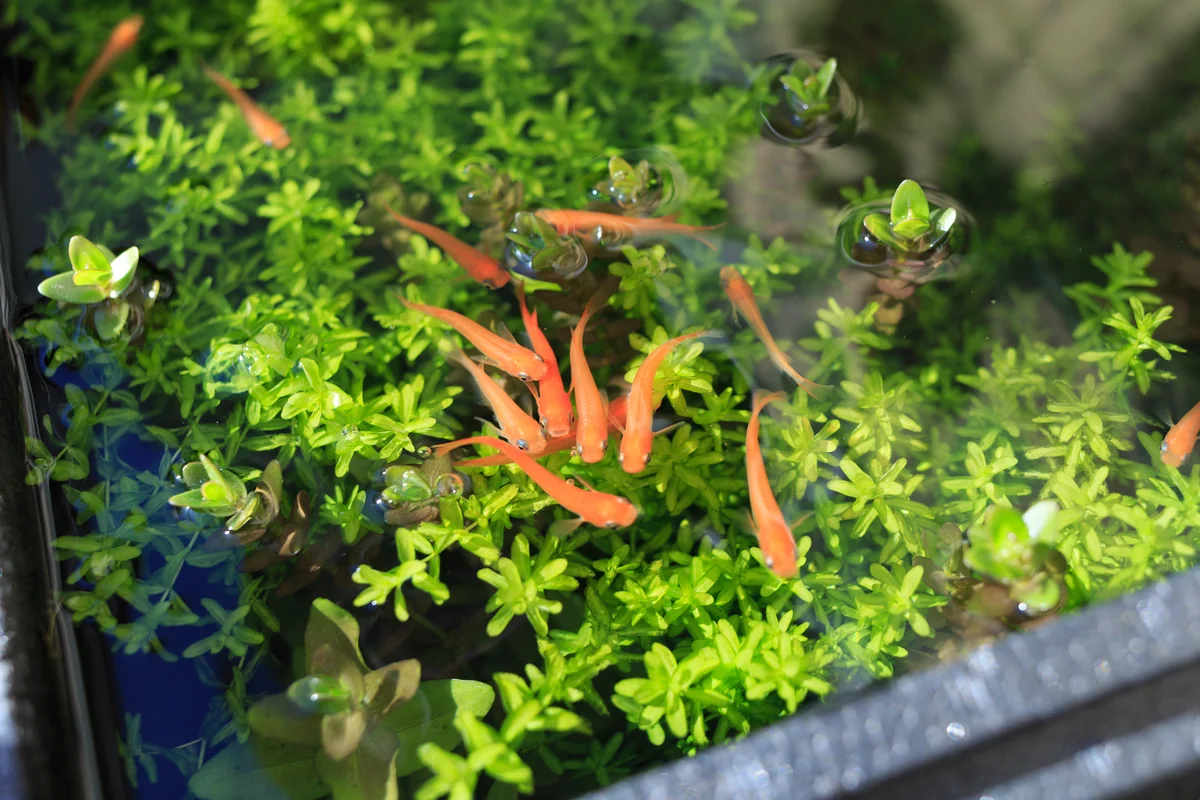
For a first medaka purchase, the Yokihi (scarlet, a deep orange-red, ~$10-20) is the right call: it’s the variety that sparked the modern boom, it’s widely available from US specialty retailers, and it shows you why hobbyists fell in love with these fish. The honest caveat: the red won’t pop unless you feed an astaxanthin-rich diet, the color literally comes from the food. Upgrade pick is the Miyuki ($20-40) for its metallic dorsal sheen if you can see your fish from above.
English-language coverage of medaka varieties is genuinely thin: most articles repeat the same four variety names with no breeder context, no realistic pricing, and zero buyer protection on the welfare-questionable extremes. This guide traces variety origins to named Japanese breeders, the year each strain was developed, and current price bands from US specialty importers, with honest framing on what’s a beginner pick, what’s collector territory, and what to refuse on sight.
Disclosure: This post contains affiliate links. If you purchase through a link on this page, we may earn a small commission at no extra cost to you. We only recommend products we’d use in our own tanks.
Why the medaka variety landscape exploded after 2004
Before 2004, medaka were either utility fish or muted-color ornamentals. Then a master breeder named Yukio Ōba (大場幸雄) selectively bred for scarlet (緋色 hi-iro, the Japan Medaka Association’s official body-color category) and released the Yokihi variety. That’s broadly cited as the spark of the modern selective-breeding boom.
From there, Japanese hobbyists built an entire competitive breeding-show culture comparable to koi sophistication. By 2023, the Japan Medaka Association recognized over 450 named varieties. New strains get released every season.
Furthermore, the pandemic accelerated everything. Japanese hobbyists in lockdown drove a domestic boom from 2020-2022, with some show-grade specimens reportedly selling for $1,000+. Western coverage followed, and by 2025 the inaugural California Medaka Fest at Nolan’s Aquarium signaled the trend’s establishment in North America. The cultural backstory traces back to centuries of Japanese rice-paddy folk-keeping, but the modern variety boom is a 2004-onward phenomenon.
How medaka color genetics actually work
Five chromatophore (pigment cell) types control medaka coloration. Understanding the basics helps you read variety names and predict what crosses between strains will produce.
- ✓ Melanophores, black pigment, dominant trait
- ✓ Xanthophores, yellow and orange, present from early development
- ✓ Erythrophores, red, but the fish cannot self-synthesize this pigment (more on that below)
- ✓ Leucophores, white and silver
- ✓ Iridophores, reflective, not pigment-based; the source of “lamé” glitter on metallic varieties
The color dominance hierarchy is straightforward: Black (B) > Red (R) > White (b). A fish with BB or Bb genotype shows wild-type black. RR or Rr produces scarlet/orange-red (Yokihi). Only bb produces white.
Two body-shape genes matter too. The Da gene creates Hikari (light-body) phenotypes: diamond-shaped tail, dorsal and anal fin symmetry, reflective cells migrating to the dorsal surface. The recessive fu gene creates the Daruma short-body type, where body length runs about 50% of normal.
Erythrophores require dietary astaxanthin. Translation: if you buy a Yokihi and feed only generic flake, the red will fade. Use a color-enhancing food like the Hikari Medaka-No-Mai Breed line, krill-based supplements, or *Haematococcus pluvialis* algae. Without astaxanthin in the diet, your $20 Yokihi looks more like a $3 himedaka within months.
The five practical variety groupings
Rather than memorize 450 names, group medaka varieties by what makes them visually distinct. There are five practical buckets.
1. Color-driven varieties
Solid or near-solid coloration. The Yokihi (scarlet orange-red), Sakura (cherry-orange), Aurora Yellow (xanthophore-rich yellow), Sapphire (brilliant blue iridophore expression), and Aoi (grey-blue iridescence from black-white crosses) all live here. This is the easiest entry tier for new collectors.
2. Two-tone and koi-pattern varieties (the “mini-koi” tier)
The Kohaku medaka (red-and-white pattern, ¥2,500-4,500 / $17-30) and the tricolor Sanshoku (red-white-black, ¥5,000-15,000+ / $33-100+) explicitly reference koi color patterns. The Goshiki (“five-color”) adds black-rim scale speckling. These are popular among koi-curious keepers who don’t have pond space.
3. Body-type varieties
The Daruma medaka (recessive fu gene, compressed body) and the Hikari (Da gene, diamond-body silhouette with reflective dorsal) sit here. The Platinum medaka (also marketed as Miyuki, ¥3,000-6,000 / $20-40) carries strong iridophore expression that creates a metallic dorsal sheen, designed specifically for top-down viewing in ceramic bowls. We’ll discuss the welfare debate on extreme Daruma phenotypes shortly.
4. Fin-extension varieties
Mariage Longfin, Tenshi (long-fin “angel”), and the recent Kinkaku (“Golden Pavilion”) cross golden body coloration with flowing fins. These read more like tropical fancy fish than traditional medaka, a deliberate aesthetic choice for planted-tank keepers.
5. Recent premium lines (2023-2025)
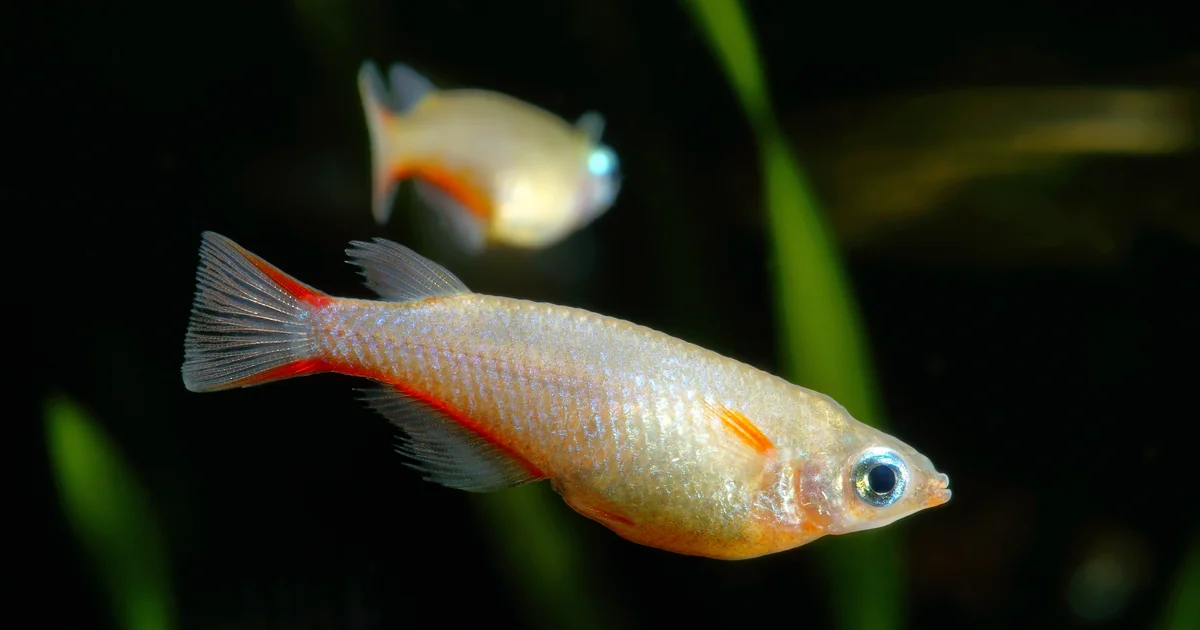
The Wazumi line has been a two-year focus for top Japanese breeders since 2023: a high-glitter darker base. Most current spin-offs trace lineage through Wazumi, including Shirogane (modern black-and-white with silver glitter and bluish eyes). Other 2024-2025 names include Taurus (red-and-white with pronounced blue eyes), Kinkaku, Sunshine (pure bright gold), Kokuu (black-rim scales on a Hikari diamond body), and Goshiki × Long-fin crosses. These are collector territory at premium prices.
The top 12 medaka varieties: pricing and origin
Here’s the reality check on what each named variety actually costs. Conversion is approximately ¥150 = $1. Prices reflect what you can expect to pay from a US specialty retailer; show-grade direct imports run dramatically higher.
Show-grade specimens direct from Japanese breeders can reach $135-1,000+ per fish. The pandemic-era peak saw some specimens reportedly sell for the equivalent of $6,000+. For a buyer starting out, anchor your expectations between $10 and $50 per fish.
Pricing reality check: what each tier actually buys
For context on what your money is buying at each tier, here’s a practical breakdown.
Under $5: Himedaka. The classic orange-domesticated medaka most people associate with the species. Beautiful, hardy, perfect for a first biotope. No pedigree, no specific breeder lineage.
$10-25: The Yokihi / Sakura / Kohaku / Aoi tier. Genuine named varieties with traceable color genetics. This is the sweet spot for a first serious medaka purchase. The Yokihi specifically gives you the variety that sparked the modern boom.
$25-60: The Miyuki / Yokihi Albino / Goshiki / Black Diamond tier. You’re paying for refined iridophore expression, recessive trait stability, or multi-color patterning. Worth it if you can appreciate the visual difference. Otherwise, stay in the previous tier.
$60-150: Premium imports. Sanshoku tricolor, Sapphire, Wazumi-line varieties, current 2024-2025 strains. This is collector territory. Make sure the seller has a reputation and ships established (not stressed) specimens.
$150+: Show-grade direct Japanese imports. Documented pedigree, specific breeder lineage (Medaka Ai, Ciel of Medaka, Arashimaya). Buyer beware: you need to know what you’re evaluating. Beginners should not start here.
Price gouging is real on eBay and unfamiliar online retailers. A Yokihi pair priced at $80 is overpriced unless it’s documented show-grade lineage from a verified Japanese breeder. Use the table above as your anchor. If a seller can’t explain why their fish costs more than the standard range, walk away.
Welfare-questionable varieties to think twice about
Not every medaka variety is created equal from a welfare standpoint. Two phenotype categories deserve careful consideration before you buy.
Daruma (extreme short-body)
The Daruma medaka carries the recessive fu gene, which compresses body length to about 50% of normal. Mild Daruma phenotypes look like a compact, rounded medaka. Extreme phenotypes look distinctly deformed.
This sits in the same ethical gray zone as Blood Parrot Cichlid and Flowerhorn, selective breeding has produced mild novelty in some specimens and serious deformity in others. Hobbyists genuinely disagree on where the line falls. The same framing applies across hybrid and extreme-phenotype fish in the broader hobby.
My honest take: a mild Daruma is a personal choice. An extreme short-body specimen that struggles to swim against a current is a welfare problem regardless of how cute it looks.
Demekin medaka (telescope-eye)
A recent phenotype that mirrors fancy goldfish telescope-eye selection. Bulging eyes look striking from the top-down viewing angle but compromise vision and increase injury risk. Same ethical framework applies: ask yourself whether you’d be comfortable with the trade-off.
The painted and dyed medaka warning
Medaka imports occasionally arrive dye-injected, the same trade trap that affects Indian Glassfish and some Blood Parrot Cichlid variants. Refuse on sight.
The warning signs are consistent across painted species: unnaturally uniform color saturation lacking species-typical variation, sharp boundaries between color regions where natural pigmentation should be gradient, color persistence at an injection site, and visible needle marks on careful inspection. Painted fish suffer high mortality rates and compromised immune function. Painted-fish identification rests on these signs; the welfare consequences are well-documented across affected species.
Crucially, painted fish are not the same as GMO fluorescent fish (GloFish). Painted = injected dye, harmful. GloFish = genetic modification, same husbandry as wild-type. Don’t conflate the two when reading retailer descriptions.
Where to actually buy medaka varieties in the US
A handful of US specialty retailers have established direct import lines from Japanese breeders. As of 2025, these are the verified options:
- ✓ SNR Medaka USA (North Carolina), group import programs from Japanese breeders
- ✓ Aquatic Arts (Indianapolis area), established standard varieties with occasional imports
- ✓ Splashy Fish Store, emerging retailer
- ✓ Nolan’s Aquarium (California), host of the inaugural California Medaka Fest in 2025
In contrast to many tropical fish in the trade, medaka are entirely captive-bred. There is no wild-collection pressure on the species. As a result, buying a named medaka variety from a reputable US retailer actually supports a captive-breeding conservation success story, Japanese wild populations are classified as Endangered by the Japan Ministry of Environment, but the global hobby has effectively become the species’ refuge. This is one of the strongest captive-bred versus wild-caught arguments in the freshwater hobby.
Reference top Japanese breeders by name to spot legitimate import lineage on retailer listings. Medaka Ai (Kinokawa City, Wakayama Prefecture), Ciel of Medaka, and Arashimaya are widely-recognized names. A retailer that can document the source breeder is more likely selling an authentic variety.
What to do with your medaka once you have them
The aesthetic that built the modern medaka hobby is top-down viewing in a suiren-bachi (ceramic lotus bowl). The metallic dorsal sheen of a Miyuki, the deep red of a Yokihi, and the koi-pattern Kohaku all look dramatically different from above than from the side. If you’re paying for a Miyuki specifically, you need to be able to see it from the top, otherwise you’re losing the visual feature you paid for.
A practical setup uses Akadama soil substrate for plant rooting and beneficial bacteria surface area. Avoid sharp gravel; medaka burrow when startled. Add hornwort bunches for nutrient uptake and egg-deposit substrate, Java moss as both fry refuge and egg-adhesion surface, and optionally Indian almond (Catappa) leaves for tannin release and biofilm cultivation. For full baseline care (tank size, water parameters, tank mates, feeding), see our Japanese rice fish care guide. For the outdoor-biotope route specifically, our medaka pond guide covers container choice, seasonal management, and stocking density.
On feeding, the Japanese standard is the Hikari Medaka-No-Mai series. For everyday conditioning of breeding adults, the Hikari Medaka-No-Mai Breed formula is the appropriate high-protein choice. For accelerating growth on jumbo lines, Hikari Saki-Hikari Growth is the go-to. For first-stage fry (hariko), use a powdered fry food, then transition to Otohime fry pellets as juveniles size up.
One more consideration on substrate color: dark substrates enhance melanophore (black) pigment expression in your fish. White substrates reduce it. This matters specifically if you’re breeding Yokihi for deep red, Sanshoku for tricolor contrast, or any variety where black pigment is part of the aesthetic. If you’re planning to scale a specific variety yourself rather than buying replacements, our medaka eggs and fry guide walks through spawning triggers, egg collection, and the critical hariko (針子) stage where most first-time breeders lose entire clutches.
Our pick for a first medaka purchase
For a first medaka, buy a Yokihi. It’s the variety that started the modern breeding boom in 2004 under Yukio Ōba. It’s the cleanest expression of selective-bred red coloration. Pricing is consistent at $10-20 from US specialty retailers. And it’s the easiest entry point for understanding how astaxanthin diet shapes color expression.
If you can comfortably view your tank or bowl from above, upgrade to a Miyuki (also marketed as Platinum medaka). The 2008-era variety carries strong iridophore expression that creates a metallic dorsal sheen specifically engineered for top-down viewing. At $20-40 you’re paying roughly double the Yokihi price for a meaningfully different visual experience.
For a koi-pattern interest, the Kohaku medaka ($17-30) gives you the red-and-white aesthetic without the pond requirement. If you want to escalate to the tricolor Sanshoku later, you’ll already understand the pattern genetics.
Skip painted imports entirely. Approach extreme Daruma phenotypes with a clear understanding of the welfare trade-off. And don’t pay $80 for a $20 variety because an opportunistic eBay seller decided to gouge.
Medaka variety FAQs
Are all medaka varieties the same species?
Yes. All 450+ named medaka varieties are Oryzias latipes, the same species. That means they interbreed freely. Keep two different color morphs in one tank and the offspring will be mixed or revert toward wild-type within a few generations. Serious breeders maintain single-variety populations specifically to preserve traits.
Can I breed two different medaka varieties together?
Technically yes, but the offspring won’t reliably show either parent’s variety traits. Most “show-quality” varieties involve recessive alleles, so crossing a Yokihi with a Miyuki produces a mixed-result generation that doesn’t match either pedigree. If you want to maintain a specific variety, keep that single variety isolated.
Why are some medaka so expensive?
Three factors: rarity of recessive trait expression, direct-from-Japan import logistics, and pedigree lineage from named breeders. Show-grade specimens with documented breeding history (Medaka Ai, Ciel of Medaka, Arashimaya) command $135-1,000+ because the pedigree itself has value to collectors. Standard varieties from US specialty retailers stay in the $10-50 range.
What’s the difference between Yokihi and Sakura medaka?
Both are red-leaning varieties in similar price ranges ($10-20). Yokihi was developed in 2004 by Yukio Ōba as a vivid deep red. Sakura (“cherry blossom”) trends toward a brighter orange-red cherry tone. Visually, Yokihi reads as deep saturated red; Sakura reads as warmer cherry. Color in both depends heavily on dietary astaxanthin.
Are glow or GMO medaka legitimate?
GMO fluorescent fish (sold as GloFish or similar) are genetically modified at the embryonic stage and require the same husbandry as wild-type. They are not the same as painted or dye-injected fish, which are harmful. Whether GMO fish align with your personal ethics is a separate question, but they are not painted, and they don’t suffer the dye-injection mortality. Painted medaka, by contrast, should be refused on sight.