Picking the best automatic vacation feeder for fish is a decision most people make backward. They buy a feeder first, then figure out whether their trip actually needed one in the first place.

Disclosure: This post contains affiliate links. If you purchase through a link on this page, we may earn a small commission at no extra cost to you. We only recommend products we’d use in our own tanks.
This guide is built on how these feeders behave on real trips, not on a spec sheet comparison. That includes the no-feeder option: for many short trips, deliberately fasting a healthy tank beats any hardware. Both paths are weighed honestly below.
Do You Actually Need an Automatic Fish Feeder for Your Trip?
Before you shop for the best automatic vacation feeder for fish, answer a simpler question first: how long is the trip, and how healthy is the fish you’re leaving behind? For a lot of common trips, the honest answer is that you don’t need a feeder at all.
So how long can fish go without food? Healthy adult freshwater fish in an established tank can generally fast for three to seven days as a routine baseline. Hardy species like bettas, goldfish, and most community fish can often handle up to ten to fourteen days without measurable harm, provided they go into the fast healthy and unstressed. That upper window is a survival ceiling, though, not a recommendation. For a betta specifically, three to five days unfed causes no measurable harm. However, the higher end of the range should be treated as a biological maximum rather than a routine plan.
For a trip of a week or less with a healthy adult community fish, betta, or goldfish, skip the feeder and just fast the tank. A slightly larger feeding the day before you leave is optional. In practice, a jammed or overfilled feeder dumping food into the tank is the bigger risk. A healthy adult fish going a week without eating is the smaller one.
For a seven to fourteen day trip, you’ve got two reasonable options. First, a reliable auto-feeder you’ve pre-tested for two to three days before departure. Second, a trusted sitter given pre-portioned daily packets so they can’t accidentally overfeed. Skip plaster-style vacation blocks. They dissolve unpredictably, and documented livestock losses from block-induced ammonia spikes outnumber losses from short, healthy fasts.
Trips longer than two weeks are a different case. So are fry, sick fish, and grazers like mandarin gobies that need steady food. For those, run an auto-feeder and arrange a human check-in on water level and equipment. A feeder alone is a single point of failure over that many days. Pairing it with even one mid-trip check meaningfully lowers your risk. Additionally, our guide to how long fish can survive a power outage is worth reading before a long trip. A dead filter or heater compounds a feeding lapse fast.
What Actually Matters in the Best Automatic Vacation Feeder for Fish
Once you’ve decided you genuinely need a feeder, the differences between models come down to a handful of criteria that matter more than the marketing photos.
- Portion consistency: Rotating-barrel feeders dispense more food per rotation when the hopper is full and less as it empties. That drift is invisible until you’re already gone, which is why a live pre-test matters more than any spec on the box.
- Humidity and moisture resistance: Hopper food is hygroscopic. Strong surface agitation, nearby air stones, open lids, or filter spray cause food, especially flakes, to absorb moisture and cake or rot inside the drum. Pellets resist this better than flakes.
- Power source: A battery powered fish feeder is simple and cheap but battery quality varies unit to unit, and a weak battery can fail silently mid-trip. USB-rechargeable and plug-in models trade that risk for a dependency on home power staying on.
- Dial vs. app complexity: Some feeders use a plain mechanical dial. Others are a wifi aquarium fish feeder you program and monitor from your phone, sometimes with Alexa voice control. More features mean more that can go wrong with a confusing setup, so weigh convenience against how comfortable you are troubleshooting an app from a hotel room.
- Food-type compatibility: Nearly every auto-feeder handles pellets and flakes. None of them handle large wafers or frozen food, so plan around that if your fish eat either.
| Product | Best For | Trip Length | Power | Price | Buy |
|---|---|---|---|---|---|
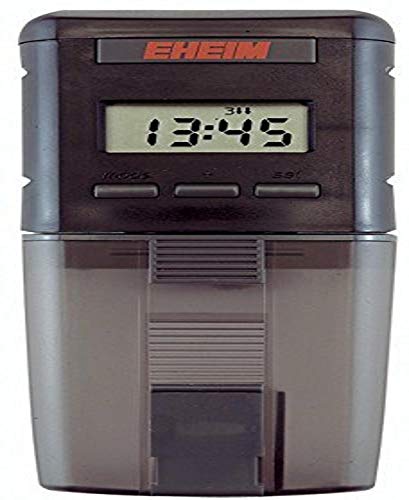
| EHEIM Everyday Fish Feeder | Trips under a week | 3-7 days | Battery | $$ |
EHEIM Everyday Fish Feeder Programmable Automatic Food Dispenser
$49.99
We earn a commission if you make a purchase, at no additional cost to you.
05/06/2026 08:08 pm GMT
|
| Petbank Rechargeable Timer Feeder | 1-2 week trips | 7-14 days | USB rechargeable | $$ | 
Petbank Automatic Fish Feeder - Rechargeable Timer Fish Feeder with USB Charger Cable, Fish Food Dispenser for Aquariums or Fish Tank
$22.99
We earn a commission if you make a purchase, at no additional cost to you.
05/06/2026 02:17 pm GMT
|
| App & Alexa-Compatible Feeder | Remote monitoring on longer trips | 7-14+ days | Plug-in outlet | $$$ | 
Automatic Fish Feeder, Aquarium Tank Feeding Timer Fish Food Dispenser Adjustable Outlet, App Control Voice Control, Compatible with Alexa.
We earn a commission if you make a purchase, at no additional cost to you.
|
| CURRENT USA AquaChef | Multiple precise daily feedings | 3-14 days | Battery | $$$ | 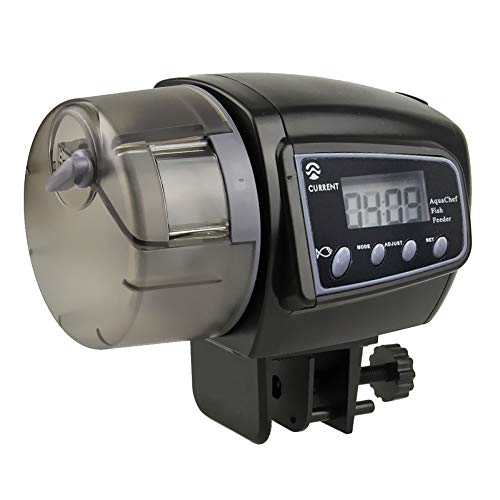
CURRENT USA AquaChef Aquarium Fish Feeder
We earn a commission if you make a purchase, at no additional cost to you.
|
| Barkmew Automatic Fish Feeder | Budget-conscious buyers | 3-7 days | Battery | $ | 
Barkmew Automatic Fish Feeder, Moisture-Proof Electric Auto Fish Feeder for Aquarium or Fish Tank, Fish Food Vacation Feeder Timer Fish Food Dispenser, 200ML, Black
We earn a commission if you make a purchase, at no additional cost to you.
|
1. EHEIM Everyday Fish Feeder, Best for Trips Under a Week
Best For: Short trips and readers who want the simplest possible setup
This is the feeder to pack for long weekends when you’d rather not fast the community tank. It’s not fancy, and that’s the point.
The dial-based portion control is easy to set correctly the first time. That matters more than any app ever will when you’re troubleshooting at 6 a.m. before a flight.
Pros
- Simple dial system with no app to configure
- Compact enough to fit most tank rims without crowding equipment
- Reasonable price point for a first feeder
Cons
- Battery-only, so no backup if the battery is weak
- No remote monitoring if you want visual confirmation from afar
- Basic dial isn’t ideal for tanks needing multiple precise daily feedings
Works for most standard community and betta tanks. Pre-test it for two to three days with your actual food before you leave.
2. Petbank Rechargeable Timer Feeder, Best for 1-2 Week Trips
Best For: Readers who want a battery backup without a full smart-home setup
The USB-rechargeable design splits the difference between a plain battery feeder and a full plug-in unit. You charge it before the trip, and it holds enough capacity that a mid-trip power blip at home doesn’t strand it.
Charged fully the night before a trip, this class of feeder is built to hold through a two-week window without a swap.
Pros
- Rechargeable battery avoids the swap-quality lottery of disposables
- Timer settings are straightforward to program
- Solid capacity for trips well past a week
Cons
- Needs a full charge cycle before departure, so plan ahead
- No app monitoring if you want visual check-ins
- Still a single unit with no built-in human check-in
Works well for 7 to 14 day trips on most tank sizes. For anything past two weeks, pair it with a check-in visit.
3. App & Alexa-Compatible Feeder, Best for Remote Monitoring on Longer Trips
Best For: Longer trips where you want to check or adjust feeding remotely
This is a wifi aquarium fish feeder that plugs into a standard outlet and lets you adjust feeding schedules from your phone, with Alexa voice control as a secondary option. If you already run smart-home devices, the setup will feel familiar.
The app is genuinely convenient when hotel wifi cooperates. When it doesn’t, you’re back to trusting the schedule you set before you left, so don’t treat remote control as a substitute for a good pre-test.
Pros
- Remote schedule adjustments from anywhere with signal
- Plug-in power removes battery failure from the equation
- Voice control is a nice extra if you already use Alexa at home
Cons
- Depends on home wifi and power staying up the whole trip
- App setup takes longer than a dial-based feeder
- Higher price than the battery-only options on this list
Best suited to tanks near a reliable outlet and router, for trips of a week or more.
4. CURRENT USA AquaChef, Best for Multiple Precise Daily Feedings
Best For: Tanks that need more than one or two feedings a day
If your fish are on a multi-feeding schedule rather than one or two drops a day, this is the feeder built for it. It handles more programmed feeding events than the simpler dial units on this list.
The honest caveat: the programming interface is not intuitive on the first try. Set aside real time to work through it before your trip, not the night before you fly.
Pros
- Supports more feeding events per day than most competitors
- Sturdy build that clamps securely to most rim styles
- Good fit for larger or multi-species tanks with varied feeding needs
Cons
- Programming menu is genuinely confusing the first time
- Higher price than feeders with a single daily drop
- Battery-only, same failure risk as any disposable-battery unit
Best for tanks that already run a multi-feeding routine, not a simple once-daily drop.
5. Barkmew Automatic Fish Feeder, Best Budget Pick
Best For: Budget-conscious buyers who want a basic, moisture-resistant unit
This is the pick for a reader who needs a one-time short trip covered without spending much. It’s moisture-resistant housing, which helps against the caking problem that ruins cheaper feeders.
Pros
- Lowest price point of the five picks
- Moisture-resistant housing helps against clogging
- Simple enough that there’s little to misconfigure
Cons
- Smaller hopper capacity than the pricier options
- No app or remote monitoring
- Battery-only, so treat the pre-test as mandatory, not optional
Best suited to short trips on smaller tanks where budget matters more than extra features.
What to Avoid When Buying a Vacation Fish Feeder
Don’t skip the pre-trip test. Run any feeder for two to three days with your actual food before you leave, not the food in the marketing photos. This single step catches the most common failures before they matter.
Don’t overfill or underfill the hopper right before you leave. Rotating-barrel feeders dispense more food per rotation when full and less as they empty, so a hopper you topped off the morning you left can behave differently than the one you tested three days earlier. Fill it to the same level you used during the pre-test.
Don’t assume a battery powered fish feeder is enough on its own for anything past two weeks. Battery quality varies unit to unit, and a weak cell can fail silently with no warning before you’re back home. For longer trips, that risk stacks with the question of home power going out while you’re away. Our guide to battery backup for aquariums covers the equipment side of that risk in more depth.
Automatic Feeder vs. a Pet Sitter vs. Not Feeding at All
The auto fish feeder vs. pet sitter question comes up in almost every vacation-planning thread, and the honest answer is that neither one is universally better. It depends on the trip length and what you’re actually worried about.
For trips under a week, not feeding at all is the lowest-risk option for a healthy adult fish, full stop. A feeder or a sitter both introduce a chance of overfeeding; a short fast introduces almost none. For seven to fourteen days, a pre-tested feeder and a sitter with pre-portioned packets are roughly comparable. Instead of agonizing, pick whichever you trust more: your own tested hardware, or a person who’ll actually show up.
A sitter has one advantage a feeder can’t match: they can notice a problem, a cloudy tank, a dead fish, a broken heater, and act on it. If you’d rather stick with a feeder but still want that kind of visibility, a tank-facing camera lets you check in visually without a person on-site. Our guide to picking a camera for your fish tank covers that option in more detail if remote peace of mind matters to you.
For trips longer than two weeks, don’t choose one or the other. Combine a feeder with a check-in, whether that’s a sitter, a neighbor, or a camera you can act on. That combination is what actually closes the single-point-of-failure gap that a feeder alone leaves open.
FAQ
Is a wifi aquarium fish feeder worth the extra cost?
Only if you actually want to adjust the schedule remotely or you like the peace of mind of an app check-in. For most trips under two weeks, a pre-tested dial or timer feeder does the same job for less money.
How long can fish go without food before it’s a problem?
Healthy adult fish typically handle three to seven days without issue, and hardy species can often stretch further. Treat anything past ten to fourteen days as outside the safe routine window, not a target to plan around.
Can I use an automatic feeder for my betta?
You can, but for trips under a week it’s usually unnecessary. A healthy adult betta can go three to five days unfed without measurable harm, so a short trip is a good candidate for simply fasting the tank instead. For a deeper look at betta feeding habits, see our betta feeding guide.
What causes automatic fish feeder clogging?
Moisture is the main cause. Humidity from air stones, filter spray, or an open lid gets into the hopper and causes food, especially flakes, to cake up inside the drum. Pellets hold up better in humid setups.
Is it cheaper to just not feed my fish on a short trip?
Yes, and it’s often the safer option too. For trips of a week or less with healthy adult fish, skipping the feeder entirely costs nothing and avoids the overfeed risk that comes with any mechanical device.
Final Recommendation: The Best Automatic Vacation Feeder for Fish
If you’ve worked through the decision tree above and landed on “yes, I need a feeder,” the EHEIM Everyday Fish Feeder is still the one I’d reach for first for most trips under two weeks. It’s simple enough to set correctly on the first try and reliable enough across a pre-test that you can leave with confidence.
If your trip runs longer or you want remote visibility, the Petbank Rechargeable Timer Feeder is the strongest runner-up for one-to-two-week trips. Meanwhile, the App & Alexa-Compatible Feeder is worth the extra cost if checking in from your phone genuinely matters to you. Whichever you choose, the two-to-three day pre-test before you leave matters more than which feeder you buy.