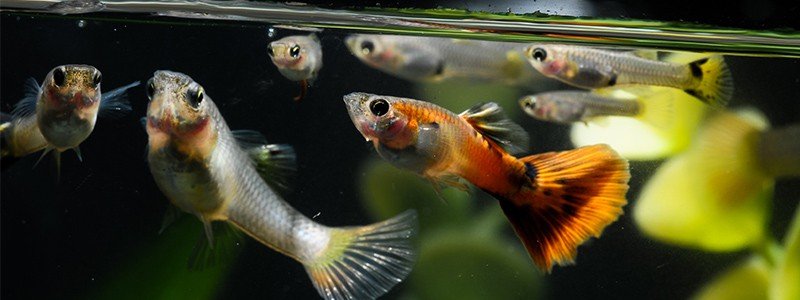
The first time I watched two of my guppies mate, it looked less like romance and more like a hit-and-run: a fast sideways bump, gone in under a second, and three weeks later my ten-gallon tank was full of fry I never planned for.
So how do guppies mate, exactly? Guppies don’t spawn like tetras or barbs, scattering eggs into open water. Specifically, the male transfers sperm directly into the female through a modified fin, and she carries the developing young inside her body until she gives birth to fully formed, free-swimming fry. No eggs ever touch the water. Below, I’ll walk through the actual mechanics, how long gestation takes, why one mating can produce babies for months, and what to do if your tank is turning into a guppy nursery faster than you’d like.
Disclosure: This post contains affiliate links. If you purchase through a link on this page, we may earn a small commission at no extra cost to you. We only recommend products we’d use in our own tanks.
How Guppy Mating Actually Works (Internal Fertilization, Not Spawning)
Guppies belong to a group of fish called livebearers, and the defining trait of that group is internal fertilization. Instead of releasing eggs and sperm into the water, the male guppy uses a modified anal fin called a gonopodium, a slender, rod-shaped structure, to deliver sperm directly into the female’s body.
Courtship usually comes first. For instance, males flare their fins, swim in tight loops, and dart alongside a female to get her attention. If she’s receptive, the male maneuvers into position and briefly touches the gonopodium to her vent. The whole transfer can happen in a second or two, which is exactly why it’s easy to miss or mistake for aggression.
Guppies aren’t unique in this reproductive strategy, either. The whole livebearer family, including platies, swordtails, and mollies, fertilizes internally rather than scattering eggs. For instance, gestation lengths vary by species: platies and swordtails typically run 28-42 days, while mollies take longer at roughly 40-70 days. Guppies sit at the faster end of that spectrum, which is part of why they multiply quickly in a mixed livebearer tank.
Guppies reach sexual maturity young, usually within 3-5 months of birth, and breeding is most reliably triggered around 78-80°F. As a result, guppy populations can spiral quickly in a warm community tank: young fish mature fast, and mating opportunities are constant once both sexes are present.
Male vs. Female Guppies: What to Look For
Before any of this makes sense in your own tank, it helps to know which fish is which. The clearest tell is the anal fin: males have it modified into that pointed gonopodium, while females keep a fan-shaped anal fin. Males are also typically smaller and more vividly colored; females are larger and plainer.
| Trait | Male | Female |
|---|---|---|
| Anal fin | Modified into a rod-shaped gonopodium | Fan-shaped |
| Body size | Smaller, around 1.5 in | Larger, around 2 in |
| Behavior | Pursuing, displaying color | Being pursued |
Furthermore, that selective breeding history is also worth knowing: livebearers as a group, and guppies in particular, have been bred more intensively for color and fin shape than almost any other aquarium fish, which is why pet-store guppies show such a wide range of tail shapes and patterns.
This is the quick version. For a full breakdown with more visual detail, our guide to telling male and female guppies apart covers it in depth.
The Gestation Period: How Long From Mating to Birth
Once mating happens, gestation usually runs 21-35 days, averaging around 28 days. Some sources put the upper bound slightly higher, at 4-6 weeks (28-42 days), which reflects natural variation between individual females and populations.
Temperature plays a real role here. Warmer water speeds up a female’s metabolism and shortens gestation, while cooler water stretches it out. In practice, that means a female kept near the warm end of the community range will often deliver closer to the 21-day mark, while one in cooler water may take closer to five weeks. Consequently, this is the same tradeoff that affects overall guppy lifespan, since warmer tanks tend to shorten lifespan even as they speed up breeding. For more on that relationship, see our guppy lifespan guide.
Sperm Storage: Why a Female Keeps Having Babies Without a Male Present
Here’s the detail that surprises a lot of new keepers: a female guppy doesn’t need a male present to keep having babies. Females store sperm internally in specialized ovarian micropockets after mating, and that stored sperm stays viable for a long time.
Hobby sources conservatively cite up to 6 months of viable storage. However, peer-reviewed research documents storage lasting up to 8 months, with at least one source claiming viability closer to a year. In practical terms, a single mating event can fertilize 5 or more successive broods without the female ever encountering another male.
The Gravid Spot: How to Tell a Female Is Pregnant
The most reliable visual sign of pregnancy in a female guppy is her gravid spot, a darkened, roughly triangular patch near the base of the tail, just above the anal fin. In particular, as the developing fry grow inside her, this spot progressively darkens and expands, making it a genuinely useful readiness indicator rather than a vague guess.
Combined with a rounder, boxier belly shape and a female who starts seeking out cover, a dark, well-defined gravid spot is usually a sign that birth is close. That’s a good moment to have a plan ready for the fry, which we’ll get to shortly.
Brood Size: How Many Fry Come From One Mating
This is where a lot of guppy content gets muddled, so let’s be precise. For example, a typical brood is 20-40 fry for an average mature female. The full biological range documented in breeding literature runs much wider, from 20 up to 200, with especially large, mature females in excellent condition producing the high end. The documented world record, from the Shedd Aquarium, is 244 fry in a single brood.
Here’s the correction worth making explicitly: brood size and brood frequency are two different things, and articles about guppy breeding constantly conflate them into claims like “30-40 fry every month.” That’s not quite right. A healthy female typically produces one brood roughly every 4 weeks, and each of those broods is usually 20-40 fry. The size stays roughly the same each time; it’s the frequency that repeats monthly. Over a year, that adds up fast, but it’s worth understanding the actual mechanism rather than treating “constant babies” as one giant undifferentiated number.
Do the math and the annual scale becomes clearer. A female producing roughly one brood every four weeks, at 20-40 fry per brood, could theoretically account for several hundred fry across a year from a single mating event, once stored sperm across multiple successive broods is factored in. Therefore, that’s the real reason guppy numbers explode from one unplanned pairing, not because any single brood is unusually large.
| Metric | Typical Figure |
|---|---|
| Sexual maturity | 3-5 months |
| Gestation | 21-35 days, averaging ~28 |
| Brood size | Typically 20-40, range 20-200 |
| Brood frequency | Roughly every 4 weeks |
| Sperm storage | Up to 6-8 months (hobby vs. peer-reviewed estimates) |
What Happens After Birth: Fry Survival and Cannibalism Risk
Guppy fry are born fully formed and swimming immediately, which is one of the advantages of livebearing over egg-laying. Unfortunately, that doesn’t mean they’re safe. Adult guppies, including the mother, will readily eat fry given the chance, so separating newborns from adults right away significantly improves survival odds.
A dense clump of floating plants gives fry somewhere to hide immediately after birth. Next, if you’re setting up a dedicated rearing space, a foam filter is the safer choice for a fry tank, since it provides filtration without the intake risk that power filters pose to tiny fish. A standard power filter’s intake is easily strong enough to pull in a fish this small, while a foam filter’s slower, gentler flow poses far less risk.
Once fry are a day or two old, brine shrimp nauplii and finely crushed flake make appropriate first foods, consistent with general livebearer fry-rearing practice. Feeding fry several small meals a day, rather than one large one, tends to support steadier growth, since growth rate at this stage tracks closely with feeding frequency.
Meanwhile, on the other end of a female’s reproductive life, it’s worth knowing that fry production doesn’t continue indefinitely. Females typically slow or stop producing broods around 18-24 months into a lifespan that averages roughly 2.3 years. That’s normal reproductive aging, not a sign of illness or a husbandry mistake, though it’s still worth ruling out water quality issues if a previously reliable breeder suddenly stops. For more on how lifespan and breeding decline connect, see our guppy lifespan guide.
Controlling Guppy Population
If your tank is already overflowing with fry, or you’d like to prevent that from happening, the sex ratio in your tank is the single biggest lever you have. A 1:1 male-to-female ratio is actually the worst setup for females, since one male’s attention falls entirely on a single fish. The standard recommendation is 1 male to 2-3 or more females, which spreads mating attempts out and reduces the chronic stress that comes from constant harassment.
| Sex Ratio | Outcome |
|---|---|
| 1 male : 1 female | Worst; female receives all mating attention |
| 1 male : 2 females | Acceptable, not optimal |
| 1 male : 3+ females | Standard recommendation; attention spreads out |
| All-female | No fry, lowest stress on females |
Nevertheless, even with a good ratio in place, it’s worth watching for signs that a male-heavy tank is still stressing your females: hiding, clamped fins, and a drop in appetite are the usual tells. If you’d rather skip breeding altogether, an all-female tank tends to run with the least aggression, since females aren’t competing over mates the way males do, though you’ll lose some of the males’ brighter coloration in that setup.
An all-male or all-female tank is a legitimate option if you want the color and personality of guppies without ongoing breeding. Additionally, if you do want to isolate a pregnant female, use a dedicated tank rather than a breeding trap. Trap stress can trigger premature birth, and confined fry tend to be stunted; a simple, heavily planted tank does the job with less risk.
Keep that dedicated space modest: a small tank in roughly the 10-30 liter range suits most livebearers, with minimal decoration to keep maintenance simple and reduce hiding spots where waste can build up. Drying the tank down and using separate nets and siphons between it and your display tank also helps avoid transferring disease back and forth.
Finally, one more thing worth flagging: guppies will interbreed with closely related livebearers, including Endler’s livebearers, producing fertile hybrid offspring. If you’re keeping guppies alongside similar species and trying to manage numbers, that cross-breeding potential matters. Our guide to guppy hybridization covers which species mix and what the offspring look like.
FAQ
Can a female guppy have babies without a male in the tank?
Yes. Females store sperm internally for months after a single mating and can produce several successive broods without a male present.
How often do guppies have babies?
A healthy female typically produces a new brood roughly every 4 weeks. Each brood is usually 20-40 fry, not 20-40 fry every single month on top of that.
How can I tell if my guppy is pregnant?
Look for a darkening, triangular gravid spot near the base of the tail, above the anal fin. It deepens in color as the fry inside develop, alongside a rounder body shape.
Do guppies eat their own babies?
Yes, adult guppies, including the mother, will readily eat fry. Separating newborns immediately or providing dense floating plant cover meaningfully improves survival.
How many fry does a guppy have at once?
Typically 20-40 fry per brood. The full documented range runs as wide as 20-200, with especially large, mature females producing the higher counts.
Final Thoughts
Guppy reproduction isn’t magic, and it isn’t really “breeding like crazy” either. It’s internal fertilization, roughly monthly broods of 20-40 fry, and sperm storage that keeps females producing young for months after a single mating. Once you understand the actual mechanics, the sudden appearance of fry in a “single-sex” tank stops being a mystery.
If population is getting away from you, the sex ratio adjustment is the highest-leverage fix, with fry separation as the practical backstop. A dedicated, simple delivery tank, kept separate from your main equipment, remains the safest way to isolate a female close to giving birth. For the full picture on keeping guppies healthy long-term, our complete guppy care guide covers water parameters, diet, and tank setup in more detail.